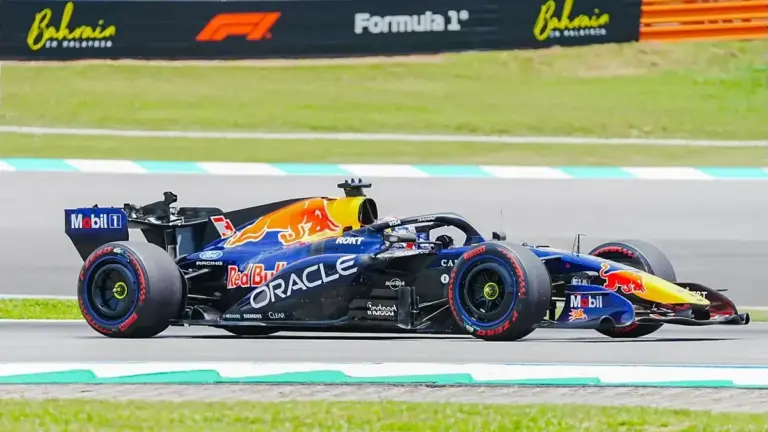
Max Verstappen has spent six years turning Zandvoort into a private orange festival. His final home Grand Prix lasted a single lap. Running seventh after a wretched qualifying and a weekend in which he admitted he had felt unwell, the four-time world champion dipped his inside wheels onto the wet painted line at the banked, flat-out Luyendyk corner, lost the rear of his RB22 and speared nose-first into the outside wall. “Yeah, that’s it — sorry,” came the radio call. The red flags followed, and with them the end of the last Dutch Grand Prix before the race disappears from the calendar.
What happened over the following 71 laps mattered rather more to the 2026 championship. Lando Norris won from pole for the second race in a row, Kimi Antonelli finished second to extend his title lead, and Formula 1’s first race after the summer break delivered team-orders friction at both Mercedes and Ferrari. The chaos was Dutch. The consequences were not.
Norris turned a messy race into a masterclass
Norris did not have the easy afternoon that Saturday’s pole position implied. He led away at the first start on a damper inside line, only to lose the lead to Antonelli at Turn 1 at the second standing start — itself delayed again when Oliver Bearman suffered an engine failure on the formation lap. Antonelli, on mediums, streaked 2.2s clear of the soft-shod McLaren.
From there it became a tyre-offset exercise, and McLaren won it. Norris stayed within range, waited for the switch to the hard compound, and on lap 54 of 72 swept around the outside of a defending Antonelli into Turn 1. Lewis Hamilton, out of sequence on his stops and briefly leading on track, was dispatched on the back straight later on the same lap. Norris crossed the line 11.5s clear for a second consecutive win, cutting his deficit to Antonelli from 90 points to 83.
Antonelli’s lead grew, but Mercedes had to ask
The headline for the championship leader is a good one: Antonelli beat both of his nearest rivals, Hamilton and George Russell, and left the Netherlands further ahead than he arrived. The route there was less comfortable. Russell, who had won Saturday’s sprint, reported balance problems and simply lacked race pace, and under a late virtual safety car he was instructed to let his team-mate through into second — a call that left him exposed to a charging Hamilton for the final podium place. A second late virtual safety car, called to recover debris, helped him hold on.
Ferrari’s afternoon carried its own radio tension as Hamilton finished fourth, just half a second ahead of Charles Leclerc, having spent the closing laps unable to turn his alternative strategy into a rostrum. Further back, Fernando Alonso’s one-stop run to ninth gave Aston Martin-Honda their first points since Monaco — quiet but real evidence of progress at a team that has spent much of 2026 waiting for it.
Red Bull’s reckoning, and a goodbye
For Red Bull, seventh place for stand-in Liam Lawson was the best of a bad day, and Verstappen was unusually blunt about why. “I wish for more, but you need to be realistic this season,” he said. “We are the fourth-fastest team, so it’s not like walking up to Zandvoort and suddenly we can do some magic things. It’s just how it is, other teams have brought upgrades, we haven’t.”
He was equally direct about the accident itself, describing the impact as “a decent hit” but conceding he had simply gone too early: “It was still quite wet in that corner, and as soon as I saw the dry patch coming, I was like, ‘Now you can accelerate’, but clearly that didn’t work.” A driver who won the first three editions of the revived Dutch Grand Prix in 2021, 2022 and 2023, and who committed his future to Red Bull until 2030 only days ago, has said farewell to his home race from inside a barrier. Norris, meanwhile, leaves Zandvoort finally hunting rather than hoping.