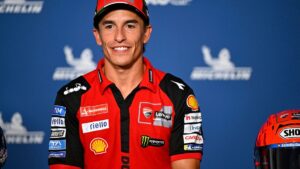
The Marc Marquez Aragon record is the most intimidating statistic in MotoGP: seven wins at MotorLand, including all four grands prix he has contested there on a Ducati. So when the reigning world champion was asked on Thursday whether he is the favourite for Sunday’s race, he did not reach for his usual deflection.
“Obviously, we are at a race track where… I like it for my riding style,” Marquez said. “I switched well in the last years. If we want to fight for the championship, we must finish in front of these [Aprilia] guys. So, we will try.”
That last sentence is the season in miniature. Round 13 opens a run of 10 races in 14 weekends, and Marquez sits fourth, 40 points adrift of leader Jorge Martin after an Aprilia-dominated Silverstone that left him seventh and audibly frustrated on the radio.
Why the Marc Marquez Aragon case is real, not a hunch
Aragon is the outlier on his 2026 calendar. Marquez has been close to unbeatable at anti-clockwise circuits — Sachsenring, Balaton Park and MotorLand among them — because those layouts load his rebuilt right shoulder far less than a right-hand-heavy track does.
He also believes the machinery is there. “It’s obvious that Aprilia found something this year, because four Aprilia riders are very fast at every race track, and especially race tracks such as Assen and Silverstone with fast corners,” he said. “Here, we have a mix of corners. I feel well with my bike, and I know that if I take the maximum potential, I can fight for the victory.”
His stablemates agree on the logic. Francesco Bagnaia and Fabio di Giannantonio both argued on Thursday that the Desmosedici should have “more potential” than the RS-GP here, likening the weekend to Brno and pointing to MotorLand’s abrasive, high-grip surface as a Ducati strength. After a Silverstone round where Aprilia looked untouchable — seven wins from the first 12 grands prix tells its own story — Borgo Panigale needs the theory to hold.
The warning inside the optimism
The complication is the one that has shadowed him all year. His “no control over my right arm” remark to the Ducati Lenovo pit wall after Silverstone was not hyperbole, and on Thursday he explained where it came from.
“After the summer break, I believed that my physical condition would be better because I gained some muscle in the gym,” he said. “[So] I approached the weekend in a normal way, riding in a good or aggressive way from FP1. But immediately when I got up on Sunday, I saw that it’s not the time to do it.”
Asked whether it related to the nerve problem that required surgery in May, his answer was blunt: “It’s related to the seven different surgeries I have in my right shoulder. So that’s it.”
The response is tactical, not medical. Marquez intends to ration himself on Fridays — fewer laps, less aggression — to reach the sprint and the grand prix with something in reserve. For a rider built on attacking from FP1 that is a real concession, and it makes his Friday pace a poor guide to his weekend.
A round of walking wounded
He is not the only one managing a body. Marco Bezzecchi, second in the championship, says the left knee he damaged in Germany before the break suffered a “slight setback” after Silverstone and that he will “have to suffer” through the run-in. Ai Ogura, third, is out of Aragon altogether following hand surgery, with Lorenzo Savadori substituting — a title contender surrendering a full weekend of points he cannot contest.
That arithmetic is why the caution matters less than the opportunity. Aprilia’s fastest rider is injured, its third-placed rider is absent, and the championship has landed at the one circuit where the champion’s limitations bite least. As we noted when assessing how the shoulder still shapes his title bid, his season’s pattern has been to underpromise and then deliver. This week he skipped the first half of that routine.
Practice begins on Friday 28 August, with the sprint on Saturday and the grand prix on Sunday. Quotes via Crash.net and Motorsport.com.