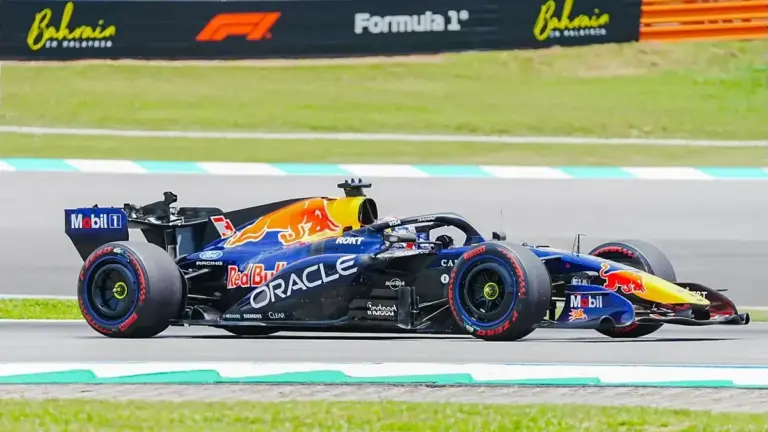
The F1 2026 rules represent the biggest single reset Formula 1 has attempted in a generation — a new power unit, a new chassis, moving aerodynamics, an extra team on the grid and two manufacturers arriving in works colours, all landing in the same winter. Here is what actually changed, and why it has reshuffled the order.
The F1 2026 rules start with the power unit
The headline is the split. Where the previous generation of hybrids drew the overwhelming majority of their output from the internal combustion engine, the 2026 units are close to an even divide between petrol and electricity. The 1.6-litre V6 remains, producing somewhere in the region of 540bhp, but electrical deployment has been lifted almost threefold to 350kW — roughly 470bhp on its own.
Two consequences follow. The first is that the MGU-H, the turbo-mounted heat recovery motor that made the previous engines so complex and so difficult for newcomers to build, has been deleted entirely. That deletion is the single biggest reason Audi, Red Bull Ford Powertrains and Cadillac were willing to commit to Formula 1 at all: the barrier to entry came down.
The second is that energy management is now the defining skill of a lap. With that much electrical power to recover and redeploy, and a smaller battery-to-power ratio than the numbers suggest, drivers and engineers are managing charge in a way that was previously the preserve of endurance racing. Deployment tapers off at very high speed — from around 290km/h upwards — specifically so that cars do not arrive at the end of a long straight with nothing left. On a circuit like Monza that calculation dominates the weekend, which is why teams target the Italian Grand Prix for engine revisions, as Ferrari did with its Monza power unit upgrade.
The fuel is the quieter revolution. Every car on the grid runs 100% sustainable fuel in 2026, produced from non-food biomass, carbon capture or synthetic processes rather than crude oil, and the fuel-flow limit is now written in energy rather than mass.
Active aero, and the end of DRS
DRS is gone. In its place sits active aerodynamics: both the front and rear wings move, switching between a high-downforce configuration for corners and a low-drag configuration for straights. Every driver has access to it at every point on the circuit where it is permitted, which means it is no longer an overtaking device at all — it is simply how the cars are driven.
Overtaking assistance instead comes from the battery. A driver running within a second of the car ahead is granted additional electrical deployment at high speed, an energy-based push-to-pass rather than an aerodynamic one. The intent was to make the pass a decision the chasing driver has to earn and manage, rather than a button that flattens the defence.
Underneath it all, the cars generate materially less grip. The FIA’s target was around 30% less downforce and roughly 55% less drag than the 2022–25 generation, with the extreme ground-effect floors of that era substantially reined in. Less downforce plus less drag equals cars that are harder to place in slow corners and faster in a straight line — a deliberate move away from the porpoising, bouncing machinery the previous rules produced.
Smaller and lighter cars
The 2026 car is the first Formula 1 car in more than a decade to get smaller. Minimum weight dropped by about 30kg to 768kg, the maximum wheelbase came down by 200mm, overall width narrowed by 100mm, and Pirelli’s tyres shrank at both ends — narrower fronts and rears on smaller rims of the same 18-inch diameter.
Nobody pretends 768kg is light by historical standards. But after a decade of cars growing longer, wider and heavier every season, and after years of drivers complaining that modern grand prix machinery could not be threaded through Monaco or Zandvoort with any precision, the direction of travel finally reversed.
Eleven teams, six engine builders
The competitive map changed as much as the rulebook. There are now 11 teams and 22 cars. Cadillac joined as the grid’s eleventh entry, running Ferrari power with Sergio Pérez and Valtteri Bottas — a rookie operation whose first season has been a hard education, as we set out in our assessment of Cadillac’s stalled development year. Audi took over the Sauber entry as a full works team with Nico Hülkenberg and Gabriel Bortoleto. Red Bull became an engine manufacturer in partnership with Ford, supplying itself and Racing Bulls. Honda switched allegiance to Aston Martin. Alpine, with Renault’s engine programme wound down, became a Mercedes customer.
That is six power unit suppliers — Mercedes, Ferrari, Red Bull Ford, Honda, Audi and, through Ferrari, Cadillac — where the previous era settled into four. The cost cap now covers engine manufacturers as well as chassis operations, which is the mechanism intended to stop a single well-funded engine department running away with the era.
What the reset has actually produced
Rules resets reward whoever reads them earliest, and 2026 has been no exception. Mercedes made the strongest start of anyone, leading the constructors’ championship through the summer break with Kimi Antonelli and George Russell, while Lewis Hamilton’s second season at Ferrari has been transformed by a car built to regulations that suit the team’s engine work. Reigning champion Lando Norris and Max Verstappen have both spent the year further from the front than either is used to.
Whether that order holds is a separate question, and one the second half of the season is answering week by week. Development curves in the first year of a new formula are steep, and a deficit identified in March is not necessarily a deficit in September. For the underlying detail, the FIA publishes the technical and sporting regulations in full at fia.com, with a plain-language summary of the changes at Formula1.com. For a sense of how the new cars interact with the sport’s fastest circuit, see our guide to Monza’s enduring F1 records.